
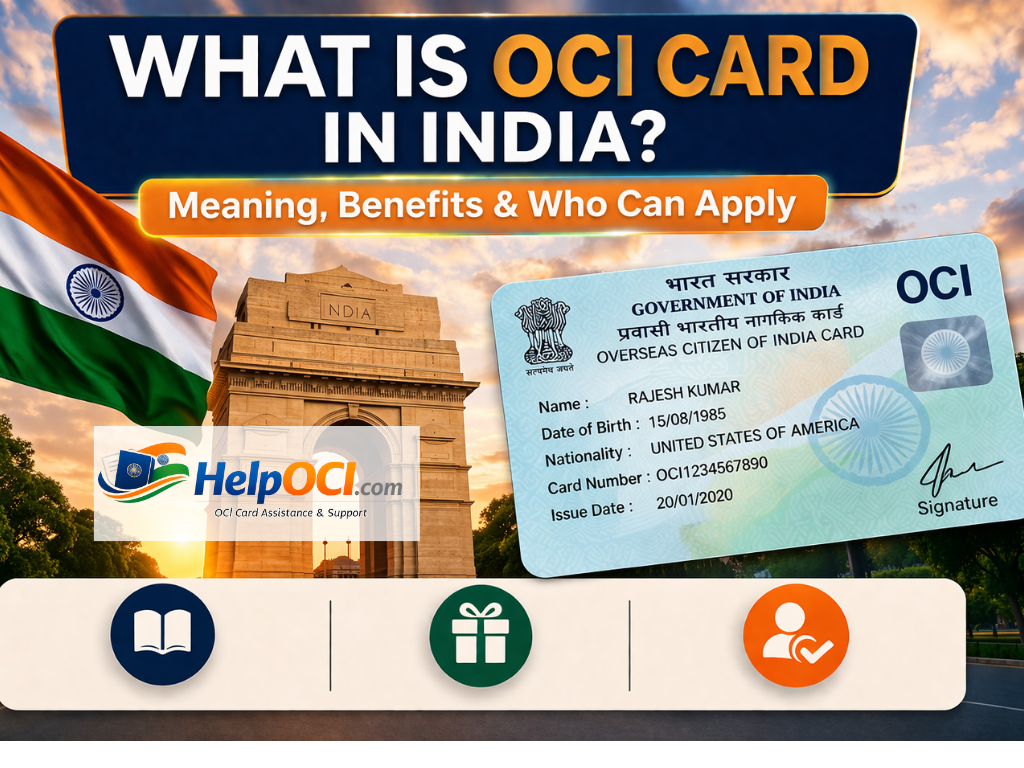
OCI Card in India is a lifelong visa issued to people of Indian origin. It’s not dual citizenship; it’s a permanent pass back to the country. Over the years, we’ve seen a massive increase in people seeking this because it solves a core problem: it provides a stable, long-term connection to India for work, family, or property without the hassle of constant visa renewals. We’re going to cover exactly what this card is, who can get it, and what it actually allows you to do on the ground.
What is OCI Card?
OCI Card is fundamentally a life-long visa for people of Indian origin who have taken up foreign citizenship. Over the years, we are expertise and seen this become the default status for millions of Indians living abroad.
The demand exists because it solves a core problem such as how to maintain a deep, practical connection to India for work, family, or property without the legal complexities of dual citizenship, which India does not permit.
Benefits of OCI Card in India
The day-to-day advantages of OCI Card in India are what make this so valuable. You stop dealing with visa applications for every trip. Look at the following benefits given below-
- You can enter India anytime, for any duration, without ever reporting to a local police station or the Foreigners Regional Registration Office
- FRRO means this is a huge operational advantage for frequent travelers or long-term residents.
- OCI cardholders are treated on par with NRIs in financial, economic, and educational matters. This means you can open and maintain bank accounts, invest in non-farm property, and pursue education. The only major exception is the inability to purchase agricultural or plantation properties.
- You are permitted to take up employment in the private sector. You don’t need a separate employment visa. For government jobs or specific regulated professions, you would still need special permission.
- You can apply for a PAN card, a driving license, and even adopt children in India, following the same procedures as NRIs.
Who Is Eligible to Apply for OCI Card in India?
Eligibility is tied directly to your Indian heritage or marital status. We handle these applications constantly, and the lines are quite clear.
Former Citizens: Anyone who was once a citizen of India on or after January 26, 1950, but later gave it up.
By Descent: Individuals whose parents, grandparents, or great-grandparents were citizens of India. The key is being able to produce the documents to prove that lineage.
By Spouse: A foreign spouse of an Indian citizen or an existing OCI cardholder is eligible, provided the marriage has been registered and has been ongoing for at least two years prior to the application.
It’s more important, if you or your ancestors have ever been citizens of Pakistan or Bangladesh, you are not eligible for an OCI card.
Do you want to take help for OCI card, you can contact here.

Final Conclusion
The OCI card is the most practical tool for a person of Indian origin with a foreign passport. It removes the friction of travel and residency, allowing you to engage with the country on your own terms. It’s a bridge, not a new identity.
People also ask Questions Regarding OCI Card
Q1: Can I vote or buy agricultural land with an OCI card?
No. Political rights like voting, holding public office, or taking up certain government jobs are reserved for Indian citizens. You also cannot purchase agricultural land or farm properties; all other types of real estate are generally permissible.
Q2: Is the old “U-visa” sticker in my passport still valid?
The government has done away with the requirement to carry the old passport that has the U-visa sticker. Your current, valid passport along with the OCI Card in India the booklet is sufficient for travel to India.
Q3: What’s the difference between an OCI and a PIO card?
The Person of Indian Origin PIO card scheme was discontinued and merged with the OCI scheme back in 2015. All existing PIO cards are now treated as OCI cards. If you still hold a PIO card, it’s a good idea to get it formally converted PIO to an OCI Card in India to avoid any confusion at immigration.