

We see it all the time, an OCI card holder lands in India, excited to reconnect, maybe buy property or invest, and then hits a wall of paperwork and confusing rules. The bank manager asks for documents they don’t have, the investment advisor talks in circles about FEMA regulations, and the insurance agent isn’t sure which policy applies. People are searching for this guide because the OCI status promises a seamless connection to India, but the financial reality is often a maze. By 2026, with more OCIs managing assets in India, this confusion will only grow. In this blog we’ll cover OCI Insurance & Financial Services, the documents you actually need, and the common traps we’ve seen people fall into for years.
Read Also:- OCI Miscellaneous Services Tracking Status: Step-by-Step Guide (2026)
What Are OCI Insurance & Financial Services?
Let’s get one thing straight, there is no special menu of “OCI products.” Banks and insurance companies don’t have a separate aisle for OCI cardholders. When we talk about OCI insurance & financial services, we are talking about the standard Indian financial products that an OCI holder is permitted to access.
For almost all financial matters, regulations treat OCI holders on par with Non-Resident Indians (NRIs). This parity is the key. You get access to the same accounts, loans, and policies as an NRI, which is a massive advantage. It means you can operate financially in India without needing special permissions for most day-to-day transactions.
Can OCI Holders Access Financial Services in India?
Yes. Absolutely. The Reserve Bank of India (RBI) has made it clear that OCI cardholders are on equal footing with NRIs for most financial and economic activities.
You can open bank accounts, invest in stocks and mutual funds, buy property (with exceptions), and get insurance. The system is designed to allow you to manage your Indian income, invest your foreign savings into the Indian economy, and protect yourself while in the country.
The permissions are broad, but they are not unlimited. The trick is knowing where the lines are drawn.

Types of Financial Services Available for OCI
Banking Services
This is your foundation. Without the right bank account, nothing else works. You have three primary choices for OCI banking services, and you must understand the difference.
- Non-Resident External (NRE) Account: Used for foreign income. Funds and interest are tax-free and fully repatriable.
- Non-Resident Ordinary (NRO) Account: Used for income earned in India. Interest is taxable and repatriation has limits.
- Foreign Currency Non-Resident (FCNR) Account: Fixed deposit in foreign currency. Interest is tax-free and protected from exchange rate fluctuations.
Loans & Credit Facilities
Getting credit in India as an OCI holder is possible but targeted.
- Home Loans: For residential or commercial property in India.
- Loans Against Property/Deposits: Based on existing assets in India.
- Car Loans: Usually requires a co-applicant or guarantor in India.
Investment Options
India’s growth story is a major draw. As an OCI holder, you have access to multiple investment options.
- Fixed Deposits (FDs): Safe and tax-free (NRE/FCNR).
- Mutual Funds: Requires PAN card and KYC completion.
- Stock Market: Requires PIS account + Demat + Trading account.
Insurance Options for OCI Holders
Health Insurance
You can buy Indian health insurance for hospital and medical coverage. Premiums are generally lower than Western countries.
Life Insurance
OCI holders can access term and investment-linked life insurance plans in India.
Travel Insurance
Covers short trips (flight delays, baggage, emergencies). Not suitable for long-term stays—health insurance is better.
Eligibility & Documents Required for OCI Insurance & Financial Services
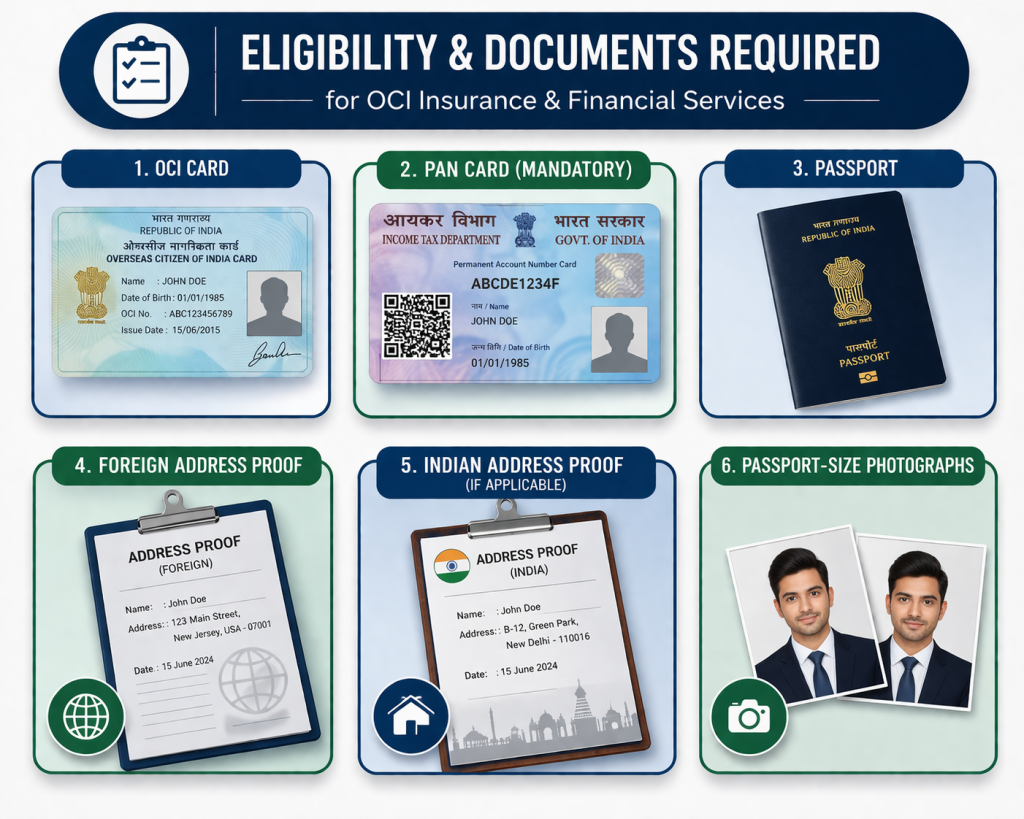
Getting your paperwork right saves time.
- OCI Card
- PAN Card (mandatory)
- Passport
- Foreign Address Proof
- Indian Address Proof (if applicable)
- Passport-size Photographs
Benefits of OCI Insurance & Financial Services
- Easy financial access in India
OCI holders can easily open bank accounts, manage money, and handle transactions in India without complex permissions or restrictions in most cases. - Direct investment opportunities
You can invest directly in stocks, mutual funds, and fixed deposits, giving access to India’s growing economy and long-term wealth-building options. - Property financing options
OCI holders can take home loans and invest in residential or commercial properties, making it easier to build assets and earn rental income in India. - Affordable healthcare coverage
Health insurance in India is cost-effective compared to Western countries, providing quality medical coverage during long stays without high expenses.
Limitations & Restrictions for OCI Holders
- Cannot buy agricultural land
OCI holders are not allowed to purchase agricultural land, plantations, or farmhouses, limiting investment options in India’s rural or farming sectors. - Limited access to government schemes
Many government-backed schemes and subsidies are restricted to Indian residents, so OCI holders may not qualify for these financial benefits. - No voting or government jobs
OCI status does not grant political rights, meaning you cannot vote in elections or apply for government jobs in India. - Must follow FEMA rules
All financial transactions must comply with FEMA regulations, especially for foreign exchange and money transfers, to avoid legal issues or penalties.
Best Tips to Choose the OCI Financial & Insurance Services
- Choose banks with strong NRI/OCI services
Banks with dedicated NRI desks understand OCI requirements better, ensuring faster processing, correct documentation, and fewer compliance issues. - Always check insurance policy details carefully
Review policy terms like waiting periods, coverage limits, and exclusions to avoid claim rejection or unexpected issues during medical emergencies. - Consult a Chartered Accountant (CA) for tax compliance
A CA helps manage taxes, filing returns, and ensuring compliance with Indian laws, especially if you earn or invest money in India.
Conclusion
OCI insurance & financial services give you strong financial access in India, but only if you understand the rules and avoid common mistakes. With the right setup—banking, investments, and insurance—you can manage your finances smoothly and take full advantage of opportunities in India.
Frequently Asked Questions
Can OCI holders open bank accounts and invest in India?
Yes, OCI holders can open NRE, NRO, and FCNR accounts and invest in mutual funds, stocks, and fixed deposits as per RBI rules.
Is PAN card mandatory for OCI financial services?
Yes, a PAN card is mandatory for most financial services in India, including banking, investments, and insurance policies for OCI holders.