
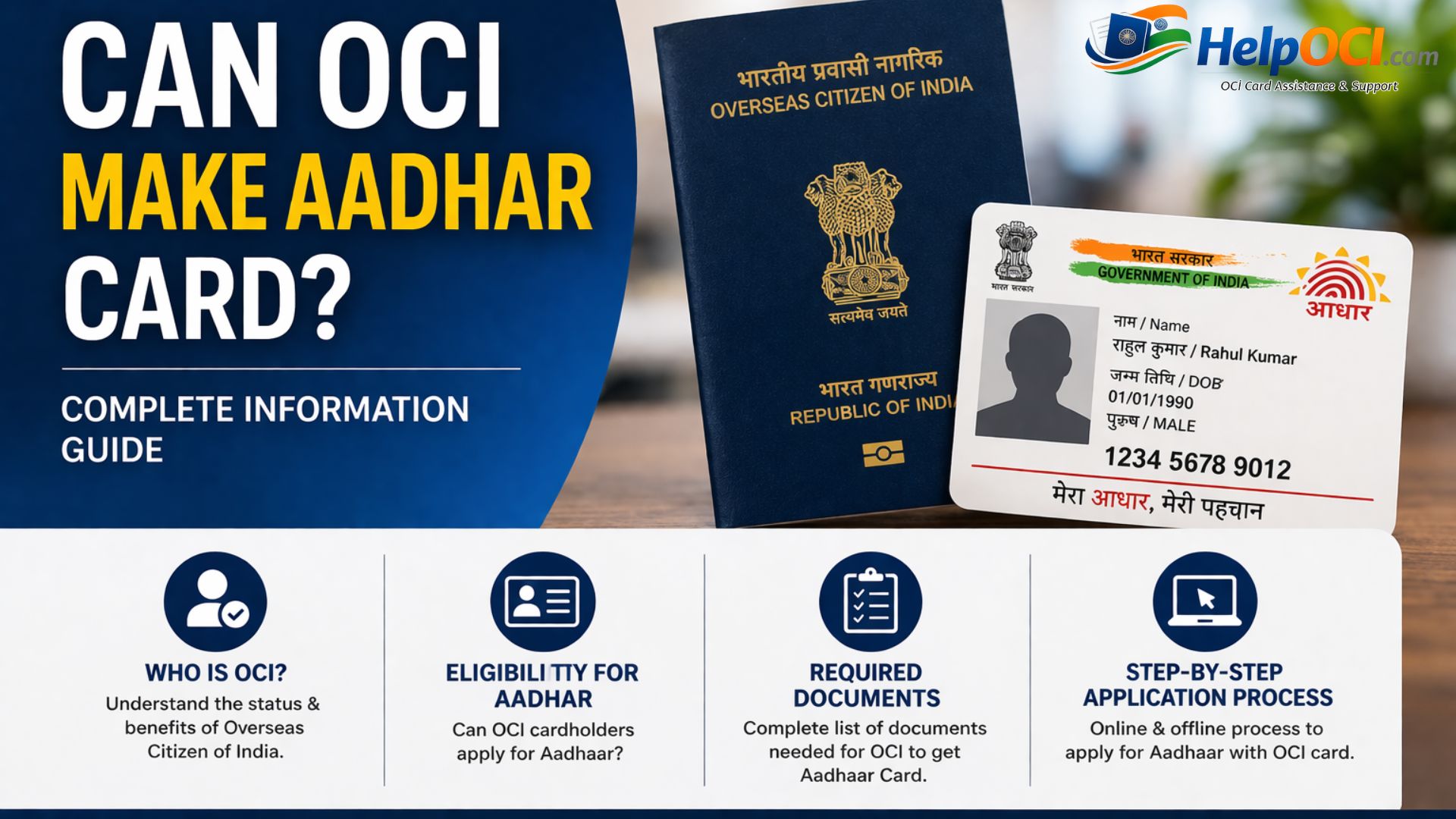
Every week, we get calls from people holding an Overseas Citizen of India (OCI) card who’ve just landed in India for a long-term stay. They try to get a local mobile SIM, open a bank account, or rent a place, and they hit the same wall every time. Someone asks, “Where’s your Aadhar card?” Suddenly, what was supposed to be a smooth transition becomes a bureaucratic nightmare.
The confusion around whether an OCI can even get an Aadhar card is huge. The rules have changed over the years, and there’s a ton of outdated or just plain wrong information floating around online.
So, let’s cut through the noise. This isn’t a government circular; it’s a practical guide based on years of helping people navigate this exact problem. We’ll cover can an can OCI make Aadhar card and more information.
What is OCI Card? (Meaning & Benefits)
Before understanding can OCI make Aadhar card, First, let’s be clear about one thing: an OCI card is not Indian citizenship. Don’t ever call it “dual citizenship,” because it isn’t. Think of the Indian OCI card as a super-powered, lifelong visa for people of Indian origin (and their spouses).
Benefits
- Live and work in India indefinitely.
- Enter and exit the country anytime without needing a separate visa.
- Own property (except for agricultural land).
- Enjoy most of the financial and economic benefits that Non-Resident Indians (NRIs) get.
It’s a fantastic document that keeps you connected to your roots without you having to give up your foreign citizenship. But it doesn’t give you the right to vote or hold a government job.
What is Aadhar Card and Why It is Important?
Aadhar is a 12-digit unique identification number issued by the Unique Identification Authority of India (UIDAI). It’s based on your biometric data (fingerprints and iris scans) and demographic information.
Frankly, in today’s India, Aadhar is everything. It started as a voluntary ID, but now it’s the backbone of nearly every private and public service. You need it to:
- Open a bank account.
- File your income tax returns.
- Get a new mobile or internet connection.
- Complete KYC (Know Your Customer) for investments.
- Receive government subsidies (though this is less relevant for most OCIs).
Without an Aadhar, you’re practically invisible to the system. It’s not just a convenience; it’s a necessity for anyone planning to stay in India for more than a short vacation.
Can OCI Holders Get Aadhar Card in India?
CAN OCI HOLDERS GET AADHAR CARD IN INDIA, Yes, OCI (Overseas Citizen of India) cardholders can apply for and obtain an Aadhar card in India. However, this is not automatic and comes with specific eligibility conditions that must be fulfilled.
The most important factor is residency status. Aadhar is not issued based on nationality or OCI status alone, it is granted to individuals who qualify as residents of India under UIDAI guidelines. This means simply holding an OCI card or entering India is not enough to apply.
To be eligible, an OCI holder must have physically stayed in India for at least 182 days or more within the last 12 months before the date of application. This requirement ensures that Aadhar is issued only to individuals who are genuinely residing in India, not just visiting.
Once this condition is met, OCI cardholders can follow the same enrolment process as Indian residents. They will need to visit an Aadhar enrolment center, submit valid documents such as a foreign passport, OCI card, and proof of Indian address, and complete biometric verification.
It is also important to understand that while OCI holders are eligible for Aadhar, the card itself does not grant citizenship or additional legal rights. It simply acts as a widely accepted identity and address proof, making everyday activities like opening a bank account, getting a SIM card, or completing KYC processes much easier.
In short, OCI holders can definitely get an Aadhar card, but only after meeting the residency requirement and completing the official application process correctly.
Eligibility Criteria for OCI to Apply for Aadhaar
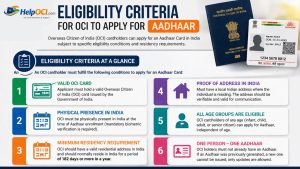
After understanding Can OCI make Aadhar card its time to know the Eligibility Criteria for OCI to Apply for Aadhaar. This is where most people get tripped up. It’s not enough to just have an OCI card; you must prove you are a resident. According to UIDAI, a resident is someone who has resided in India for a specific period.
The 182-Day Rule
To be eligible for an aadhar card for oci, you must have lived in India for 182 days or more in the 12 months immediately preceding the date of your application.
Let me break that down with an example. If you want to apply for Aadhar on December 1, 2024, you must have been physically present in India for at least 182 days between December 1, 2023, and November 30, 2024. The days don’t have to be consecutive. They just need to add up to 182 within that one-year window.
This is a strict, non-negotiable rule. Showing up at the enrollment center after a month in the country will get your application rejected.
Once you meet the residency requirement, you’ll need a set of documents. Don’t just show up with your OCI card. We’ve seen people turned away for missing one simple paper.
Here are the DOCUMENTS REQUIRED FOR OCI AADHAR APPLICATION:-
- Valid Foreign Passport: This is your primary proof of identity.
- Valid OCI Card: This proves your status and your link to India.
- Proof of Address (PoA) in India: This must be a current address. Acceptable documents include a registered rental agreement in your name, bank statement or passbook showing your Indian address (usually from the last 3 months) and an electricity, water, or gas bill (also from the last 3 months, and it must be in your name).
- Proof of Date of Birth (DoB): Your foreign passport usually covers this.
- Aadhar Enrolment Form: You can download this from the UIDAI website and fill it out beforehand to save time.
Expert Tip: A registered rent agreement is one of the strongest address proofs you can provide. It’s officially documented and less likely to be questioned by the officials at the Aadhar center.
Step-by-Step Process to Apply for Aadhaar Card
The process is straightforward, but it requires patience.
- Find an Aadhar Enrolment Centre: Go to the official UIDAI website and use the “Locate an Enrolment Center” feature.
- Book an Appointment (Highly Recommended): Many centers are crowded. Booking an appointment online can save you from waiting in line for hours. It’s a game-changer.
- Fill the Enrolment Form: Make sure your name, date of birth, and other details match your passport and OCI card exactly. Any mismatch will cause problems.
- Visit the Centre on Your Appointment Date: Take all your original documents along with one set of photocopies. The operator will verify your documents.
- Provide Your Biometrics: They will take your photograph on the spot, scan all ten of your fingerprints, and take an iris scan of both eyes.
- Review and Confirm: The operator will show you all the details on the screen. Check every single letter for spelling errors. This is your last chance to correct any mistakes before the data is locked.
- Collect the Acknowledgement Slip: You’ll be given a slip with a 14-digit Enrolment ID (EID). Do not lose this slip. It’s the only way to track the status of your Aadhar card application.
Your Aadhar card will be generated and mailed to your Indian address. This can take anywhere from a few weeks to 90 days. You can check the status online using your EID.
Expert Tip: Use an Indian mobile number on your application form. All communications, updates, and future One-Time Passwords (OTPs) for Aadhar-related services will be sent to this number. Using a foreign number is not a good idea.
Important Rules OCI Holders Must Know
Aadhar is Not Citizenship Proof
Aadhar card is only a resident identity proof, not citizenship. It does not grant voting rights, government jobs, or any additional legal status beyond OCI benefits.
182-Day Residency Rule is Mandatory
OCI holders must complete at least 182 days of physical stay in India within the last 12 months before applying. Without this, application will be rejected.
Biometric Updates for Children
Children with Aadhar must update biometrics at age 5 and 15. This is mandatory and ensures accurate identification as physical features change with age.
Keep Details Updated Always
If you change address, phone number, or personal details in India, update your Aadhar immediately to avoid issues with banking, SIM cards, and KYC processes.
Document Consistency is Very Important
Ensure your name, date of birth, and address match across passport, O
Benefits of Aadhaar Card for OCI Holders
Once you have it, life in India becomes dramatically simpler. You can:
- Easily open a resident bank account.
- Get a local SIM card in minutes using e-KYC.
- Invest in mutual funds and stocks without extensive paperwork.
- File Indian income taxes if you are earning in the country.
- Use it as a valid photo ID across India.
FAQS: OCI AND AADHAR CARD
1.Can I apply for Aadhar immediately?
No. You absolutely must fulfill the 182-day residency requirement in the last 12 months before applying. There are no shortcuts.
2. Is getting an Aadhar card mandatory for an OCI holder living in India?
Legally, it’s not “mandatory” for you to simply exist in the country. However, practically speaking, it is impossible to function effectively in modern India for any extended period without one. For all intents and purposes, consider it essential.
Conclusion: Can OCI make Aadhar card
So, can OCI make Aadhar card? The final, definitive answer is yes, provided you are a resident who has spent at least 182 days in India in the preceding year.
The oci card India is your ticket to enter and live here, but the Aadhar card is your key to unlocking daily life. It’s a shift from being a visitor to being a resident.
Looking ahead to 2026, India’s push for digitization will only intensify. Aadhar is already central to this, and its importance will continue to grow. It will likely become even more deeply integrated into property, healthcare, and financial services. For any OCI holder planning a long-term future in India, getting an Aadhar is no longer an option—it’s a fundamental step toward a hassle-free life.