
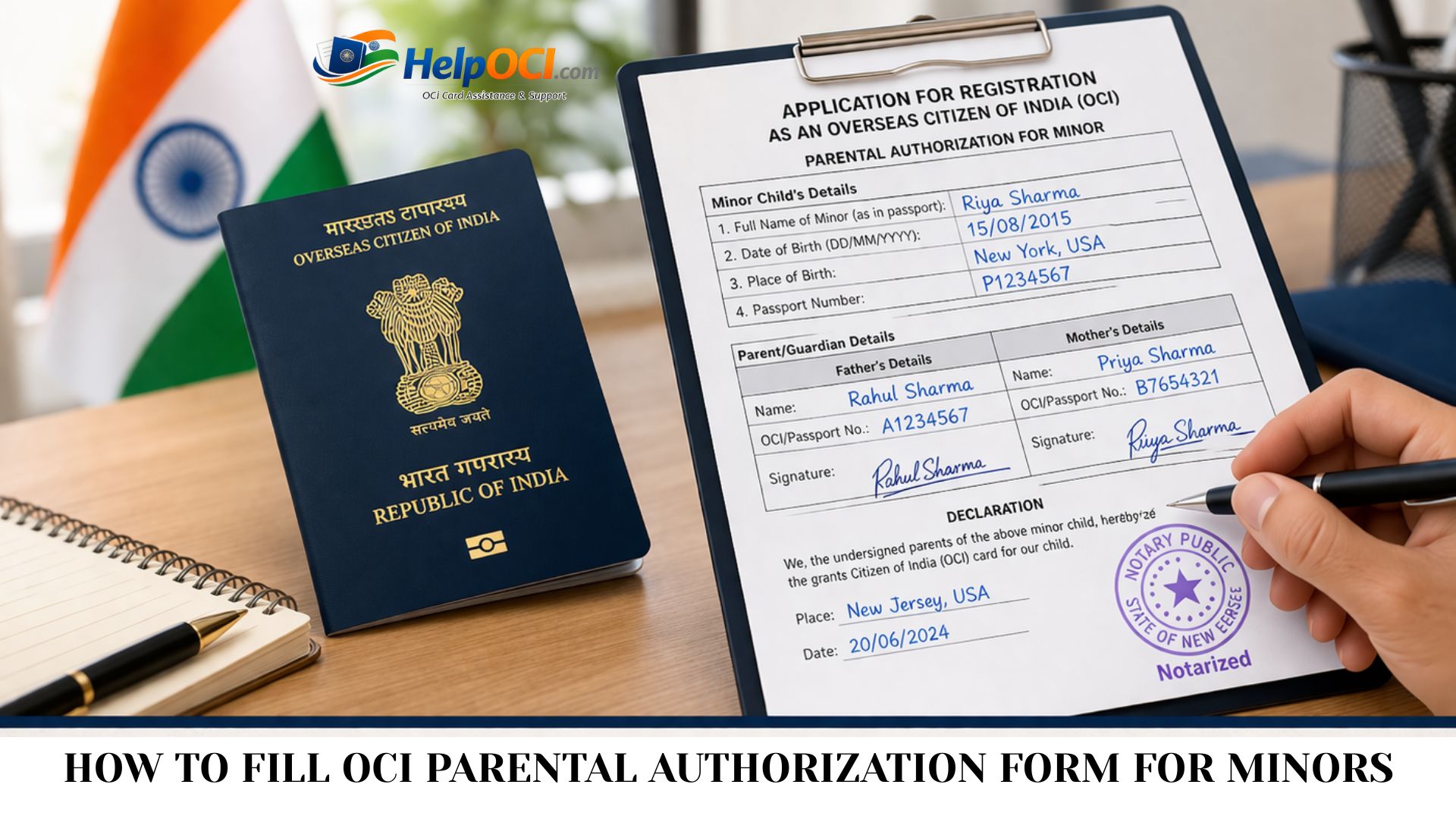
Getting an OCI card for your child should be straightforward, but many parents get stuck on one specific document: the Parental Authorization Form. It may look simple, but even a small mistake like a mismatched signature or a missing notary stamp, can lead to rejection and unnecessary delays. What should take weeks can easily turn into months.
The problem? Official instructions are often too basic, leaving you guessing at critical steps. If you’re here, you’re likely already filling out the OCI application and want to make sure this form is done correctly the first time.
In this guide, we will learn How to Fill OCI Parental Authorization Form for Minors , and common mistakes, based on real application issues, so you can complete your child’s OCI process smoothly, without delays or rejections.
Read Also:- OCI Card Immigration Problems: Real Cases & Solutions
Who Needs the Parental Authorization Form for OCI?
Every single applicant under the age of 18 needs this form. There are no exceptions. It doesn’t matter if the child is 17 years and 11 months old or just six months old. If they are a minor, this form is mandatory.
The Indian government requires this document as legal proof that both parents consent to their child obtaining an Overseas Citizen of India card. It’s a protection mechanism to ensure one parent cannot apply for the OCI without the other’s knowledge, especially in cases of separation or divorce. It confirms that this is a joint decision. From what we’ve seen, this is a non-negotiable part of the OCI minor application form process.
Documents Required Along with the Authorization Form
The form doesn’t stand alone. It’s part of a package, and you need to have the supporting documents ready to go. Submitting the form without these is an automatic rejection.
Here’s the checklist we use:
- Parents’ Current Passports:- Clear copies of the information pages of both parents’ passports.
- Parents’ Proof of Legal Status:- Copies of their visa, Green Card, or proof of citizenship in the country where you are applying.
- Parents’ OCI Cards (if they have them):- copies of the first and last pages.
- Minor’s Birth Certificate:- A copy of the child’s official birth certificate that clearly lists both parents’ names. This proves the relationship.
- Proof of Address:- A utility bill or driver’s license matching the address on the application.
- Marriage Certificate of Parents:- A copy is required to establish the relationship between the consenting parents.
- For Divorced/Separated Parents:- You must provide the court order of divorce and the legal custody order for the child. The parent with legal custody must sign the form.
- For a Deceased Parent:- A copy of the parent’s death certificate is required. The surviving parent signs the form.
Have these scanned and ready before you even touch the authorization form. It makes the whole process smoother.

Step-by-Step Guide: How to Fill OCI Parental Authorization Form for Minors
This is where precision matters. Follow these steps exactly.
Step 1: Download the Correct Form
Do not use a form your friend sent you from their application last year. The forms get updated. Go directly to the VFS Global website for your country (USA, UK, Canada, etc.) and navigate to the OCI services section. Find the “Forms” or “Documents” section and download the latest version of the “Parental Authorization Form for Minors.” It’s a PDF. Print it out on clean, white paper.
Step 2: Fill Minor’s Basic Details
- Use a black ink pen:- Write clearly and in capital letters.
- Full Name of Minor:- Write the child’s full name exactly as it appears on their passport. Do not use nicknames. If their name is “Alexander,” don’t write “Alex.”
- Date of Birth:- Use the format specified on the form, which is usually DD/MM/YYYY.
- Passport Number:- Enter the minor’s foreign passport number. Double-check it.
Step 3: Enter Parent/Guardian Information
- Father’s Details:- Fill in the father’s full name, address, and passport number. The address should match the proof of address document you are submitting.
- Mother’s Details:– Do the same for the mother. Full name, address, and passport number.
Step 4: Signatures of Both Parents
This is the most critical step and the source of most rejections.
- Both parents must sign the form in the designated signature boxes.
- The signature MUST match the signature in each parent’s respective passport. If your passport signature is a full cursive signature, replicate that exactly. If it’s a simple scribble, use that scribble. Consular officials will compare them.
Step 5: Notarization Requirements
This form is legally invalid without being notarized.
- Take the unsigned form, your passports (or valid photo IDs like a driver’s license), and your child’s documents to a registered Notary Public. Banks, shipping stores (like UPS), and law offices often have notaries.
- In front of the notary, both parents will sign the form in their respective boxes.
- The notary will then verify your identities, witness your signatures, and then sign and stamp the form with their official seal.
- The notary section will include the date, their signature, their commission expiry date, and the official stamp/seal. Make sure the notary fills out their part completely. An incomplete notary section will get the form rejected.
Common Mistakes to Avoid While Filling OCI Parental Authorization Form
Over the years, we’ve seen the same handful of mistakes sink applications. Avoid these at all costs.
- Signing Before Notarization:- This is the number one error. Parents sign the form at their kitchen table and then take it to the notary. The entire point of a notary is to witness the act of signing. If they don’t see you sign it, they cannot legally notarize it.
- Mismatched Signatures:- The signature on the form looks different from the one in the parent’s passport. Practice signing it a few times on a separate piece of paper if you need to.
- Using an Outdated Form:- VFS and the Indian government update their forms periodically. Using an old version you found online is a surefire way to get a rejection. Always download it fresh from the official source.
- Forgetting Supporting Documents for Special Cases:- If you are a single parent due to divorce, you MUST include the custody paperwork. If a parent is deceased, you MUST include the death certificate. The form alone is not enough in these situations.
Common Questions We Get All the Time
What if one parent is not in the same country?
This happens a lot. The parent who is abroad needs to get the form notarized by a notary in their country of residence. They can then mail the physically notarized form back to the parent who is submitting the application. Both parents’ signatures and notarizations must be on the same form. Sometimes, the foreign notarization also needs an “Apostille,” so check the specific requirements of your consulate.
My child’s other parents are not cooperative. What do I do?
This is a tough situation. The Indian government requires the consent of both biological parents. If you have a court order granting you sole legal and physical custody with the explicit right to apply for a passport and citizenship for the child, that may be accepted. You will need to submit this court order with the application and a letter explaining the situation. It is handled on a case-by-case basis.
Do we need to get the form notarized if both parents are present at the VFS center during submission?
Yes. The notarization is a mandatory requirement regardless of whether you submit the application in person or by mail. The VFS staff are not notaries and cannot act as witnesses for this legal document. Get it notarized before you go to your appointment.
Final Thoughts
The OCI Parental Authorization Form is a simple document, but it operates on a zero-error policy. The process is rigid. There is no room for interpretation. Every detail—the name spelling