
Visa
Indian e-X1 Visa 3 Months: Can You Extend or Convert It in India? (2026 Guide)Indian e-X1 Visa 3 Months: Can You Extend or Convert It in India? (2026 Guide)

India has always been a popular destination for travellers from around the world, whether they come to explore its rich culture, experience its diverse traditions, visit family and friends, or enjoy its natural beauty. Over the years, the country has welcomed visitors with different travel interests and purposes, making its visa system an important part of the overall travel experience.
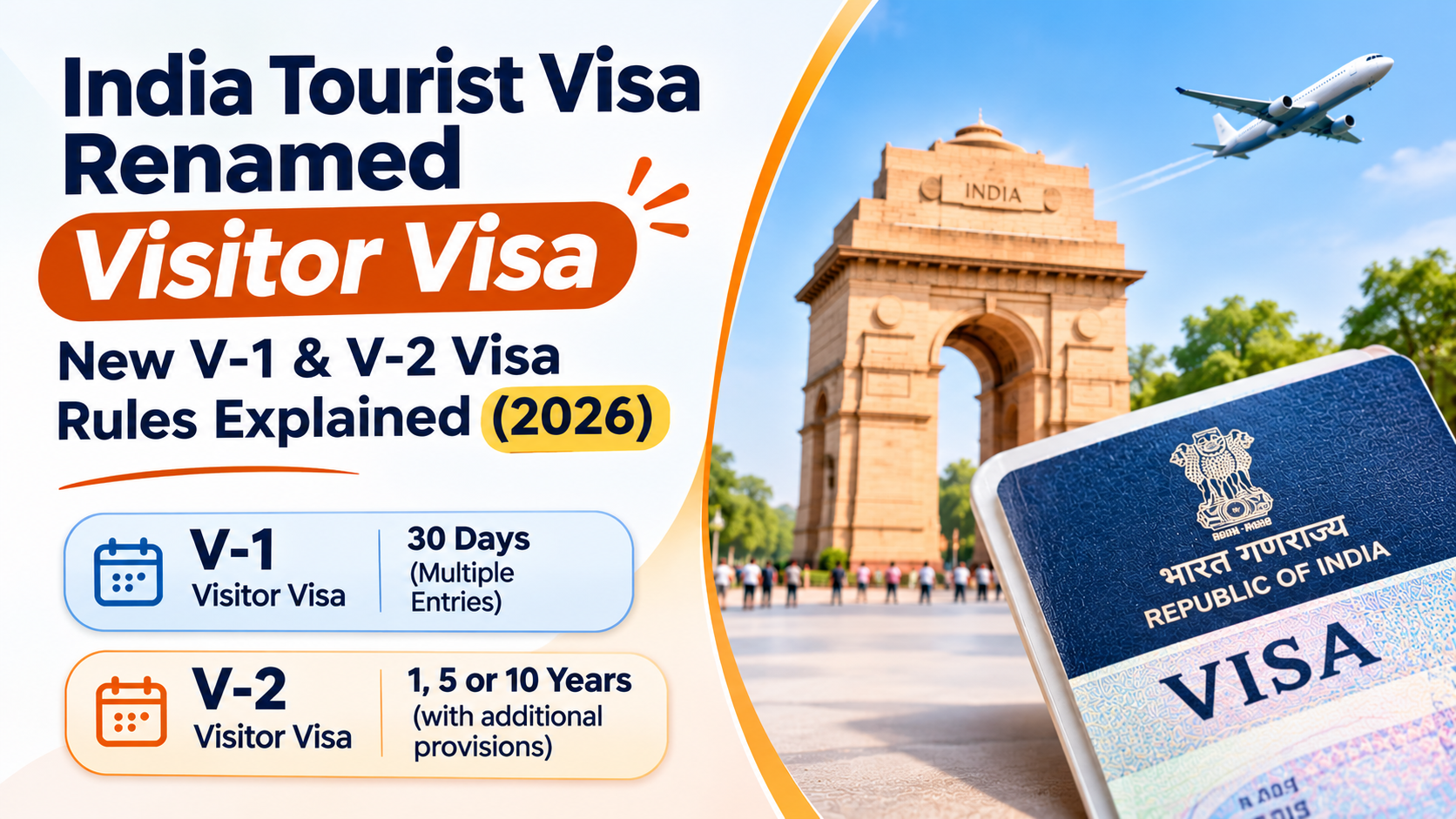
On 11 November 2026, the Ministry of Home Affairs announced that the Tourist Visa will become the Visitor Visa and introduced two subcategories, V-1 and V-2, under the revised framework. The change is not limited to a new name. The Visitor Visa now covers a wider range of eligible activities, including tourism, short-term business meetings, medical consultations, wellness retreats and certain cultural courses. The two subcategories are designed to accommodate visitors with different travel purposes and durations.
In this guide, we explain the V-1 and V-2 visa differences, eligibility, documents, application process, important restrictions and what foreign travellers should know before visiting India.
India's new Visitor Visa system is an updated visa framework introduced in 2026, replacing the existing Tourist Visa structure with two categories: V-1 and V-2. These categories are designed to accommodate different short-term travel purposes, including business meetings, medical consultations, cultural activities and mountaineering, making it easier for international visitors to choose a visa based on their travel plans.
Travellers should also understand the difference between an Indian Visa and X (Entry) Visa before selecting the appropriate category for their stay in India."
India replaced the Tourist Visa with the Visitor Visa to simplify entry rules and accommodate modern, multi-purpose travel under one clear category.
Here are the 5 main reasons behind the change and its impact:
Combine multiple activities legally: Travellers can now mix sightseeing with short business meetings, yoga retreats, medical consultations, or brief art/language courses on one visa without risking rule violations.
Improve application clarity: Help applicants understand which visa category matches their intended visit.
Cut paperwork by 65–70%: Application forms now have far fewer fields, saving applicants time and reducing rejections caused by minor form-filling errors.
Speed up immigration and approvals: Cleaner, purpose-based categories allow consulates and border officers to verify applications and clear travellers faster.
Boost international tourism: Aligning with global visa standards makes India more welcoming and straightforward to visit for leisure, wellness, and short-term business travellers.
Simplified visa categories: Cutting India’s visa framework from 49 sub-categories down to 23 removes overlapping and confusing options.
Longer validity options for repeat visitors: Frequent travellers can opt for 1-, 5-, or 10-year V-2 validity instead of reapplying before every trip.
India's new Visitor Visa has two subcategories based on the nature and duration of the proposed visit — V-1 & V-2 Visa. Let us quickly understand the difference between them:
|
Comparison |
V-1 Visitor Visa |
V-2 Visitor Visa |
|
Main purpose |
Short-term visits |
Longer-duration visits |
|
Eligibility |
Foreign nationals undertaking eligible visitor activities |
Foreign nationals undertaking eligible visitor activities, including mountaineering |
|
Permitted activities |
Tourism, short-term business meetings, medical consultations, wellness retreats, short-duration medical treatment and eligible short courses |
Activities permitted under V-1, along with mountaineering |
|
Validity |
30 days |
1, 5 or 10 years, as specified |
|
Entry |
Multiple entries |
Multiple entries |
|
Special provision |
Short-term visitor activities |
Separate six-month multiple-entry provision for mountaineering |
Choosing the right visa actually depends on your purpose.
V-1 is the one for a short trip. A holiday, a short business meeting, a doctor's consultation, a wellness retreat, a yoga programme or a short cultural course all fit, as long as you're staying within its 30-day validity. Multiple entries are allowed during that period.
If you visit India often, V-2 is built for you. Instead of applying for a new visa each time, you could get one that's valid for one, five or ten years, depending on eligibility. That suits people who visit family every year or return for work meetings regularly. How eligibility will be decided, and who gets the 10-year version, hasn't been spelled out yet.
Not sure which visa category suits your travel plans? Get expert guidance before applying.
GET VISITOR VISA ASSISTANCE →India's new Visitor Visa is available to foreign nationals who wish to visit the country for tourism and other permitted short-term activities. This includes:
Foreign tourists visiting India for holidays and sightseeing.
People visiting family and friends.
Travellers attending short-term business meetings.
Individuals coming for medical consultations or short-term treatment.
Visitors interested in wellness retreats and short yoga programmes.
People taking short courses in Indian languages, music, art or craft.
Foreign nationals planning mountaineering activities in India.
Applicants should be ready with the following list of the documents before applying for a visiting Visa:
Valid passport: Must be valid for at least six months from your planned date of arrival in India and contain at least two blank pages for immigration stamps.
Recent photograph: A clear, front-facing passport-style photo meeting the official portal’s size and background specifications.
Travel details: Proposed travel dates, itinerary and information about the intended visit.
Accommodation details: Hotel booking or other accommodation information, where required.
Purpose of visit: Explaining why the applicant is travelling to India.
Additional supporting documents: You may be asked to provide some other supporting documents such as business meeting details, medical consultation information, course details,. Etc depending on the purpose of travel. So, keep those ready.
Once the MHA completes its backend IT rollout by the end of 2026, applying for a V-1 or V-2 visa will follow a streamlined digital workflow:
Visit the Official Portal: Go to the Government of India’s official visa website (indianvisaonline.gov.in).
Identify Your Travel Purpose: Be clear whether you're coming for a holiday, a business meeting, a consultation, a course or a climb.
Select V-1 or V-2: Once the purpose is clear, apply for an appropriate Visa. Choose V-1 for 30-day multiple-entry visits or V-2 if you qualify for 1-, 5-, or 10-year validity (or 6-month mountaineering).
Fill in the application form: Enter your details exactly as they appear on your passport. The form is expected to be shorter than before.
Upload Required Documents: Upload the required documents such as digital photograph, passport scan, and any activity-specific documents requested by the portal.
Pay the Visa Fee: Pay the applicable processing fee online using an accepted international payment method.
Submit and Track Status: Submit your application and use your application ID on the official portal to monitor approval updates.
Finalize Travel Plans: Once your Electronic Travel Authorization (ETA) or visa is approved, print a copy to carry with your passport and confirm your flights.
Avoid confusion with visa categories, documentation and application requirements. Let our team guide you through the process.
CONTACT OUR VISA EXPERTS →Before applying or boarding a flight, keep these practical rules in mind so you do not run into trouble at immigration:
1. Check Live Portal Status Before Applying:
The MHA announced these reforms in November 2026 with full IT implementation scheduled by year-end. Until the official portal switches over, existing e-Tourist Visa categories remain active.
2. Validity Is Not the Same as Stay Duration:
Holding a 5-year or 10-year V-2 visa does not mean you can live in India continuously for years. Always check the maximum continuous stay limit printed on your visa grant (historically capped at 90 to 180 days per visit/calendar year depending on nationality).
3. No Paid Employment or Long-Term Study:
Even though V-1 and V-2 allow short business meetings and brief art or language courses, you cannot take a salaried job in India, run commercial operations, or enroll in a full-time university degree. Those require separate Work (W), Business (B), or Student (S) visas.
4. Intensive Medical Treatment Requires a Medical Visa:
Quick medical consultations and wellness retreats are fine under the Visitor Visa, but planned surgeries or inpatient hospital stays still require an M-1 or M-3 Medical Visa.
5. Mandatory e-Arrival Card:
Regardless of your visa type, foreign nationals must submit India’s digital e-Arrival Card within 72 hours prior to landing.
6. Approved Entry Points:
If you travel on an electronic visa, you must enter India through designated international airports or seaports equipped for biometric verification.
If your travel or stay requirements change and you need to explore another visa category, read our guide on how to convert a visa to an X Visa in India to understand the applicable process.
India's decision to rename the Tourist Visa as the Visitor Visa is an important step towards simplifying its immigration framework. The introduction of V-1 and V-2 provides different options for eligible short-term and longer-duration visits, including tourism, business meetings, medical consultations and other approved activities. However, the revised application system is still being implemented. Foreign travellers should check the latest official guidelines, confirm their eligibility and select the appropriate visa category before submitting an application.
Note: This guide is for information purposes only. HelpOCI or the author will not be responsible for any direct or indirect loss incurred by the reader for taking any decision based on the information or the contents. It is advisable to consult a qualified professional for guidance based on your exact situation.
Anil is an NRI documentation and immigration specialist at HelpOCI, a trusted platform dedicated to simplifying OCI, PAN, Visa, Passport, and NRI-related services for applicants worldwide. With extensive expertise in Indian consular services, overseas documentation, OCI applications, PAN card services, visa assistance, passport renewals, and NRI compliance, Anil is committed to making complex government procedures easier to understand and navigate. By combining in-depth research with official government guidelines, Anil creates practical, accurate, and easy-to-follow resources that help applicants complete their documentation confidently and efficiently See Full Bio
Get reliable support for every step, whether it's form filling or final submission.




Want to read more? Explore Blogs


Comments