
Passport
How to Surrender Indian Passport in USA: Complete Process & Documents (2026)How to Surrender Indian Passport in USA: Complete Process & Documents (2026)
Written by Anil

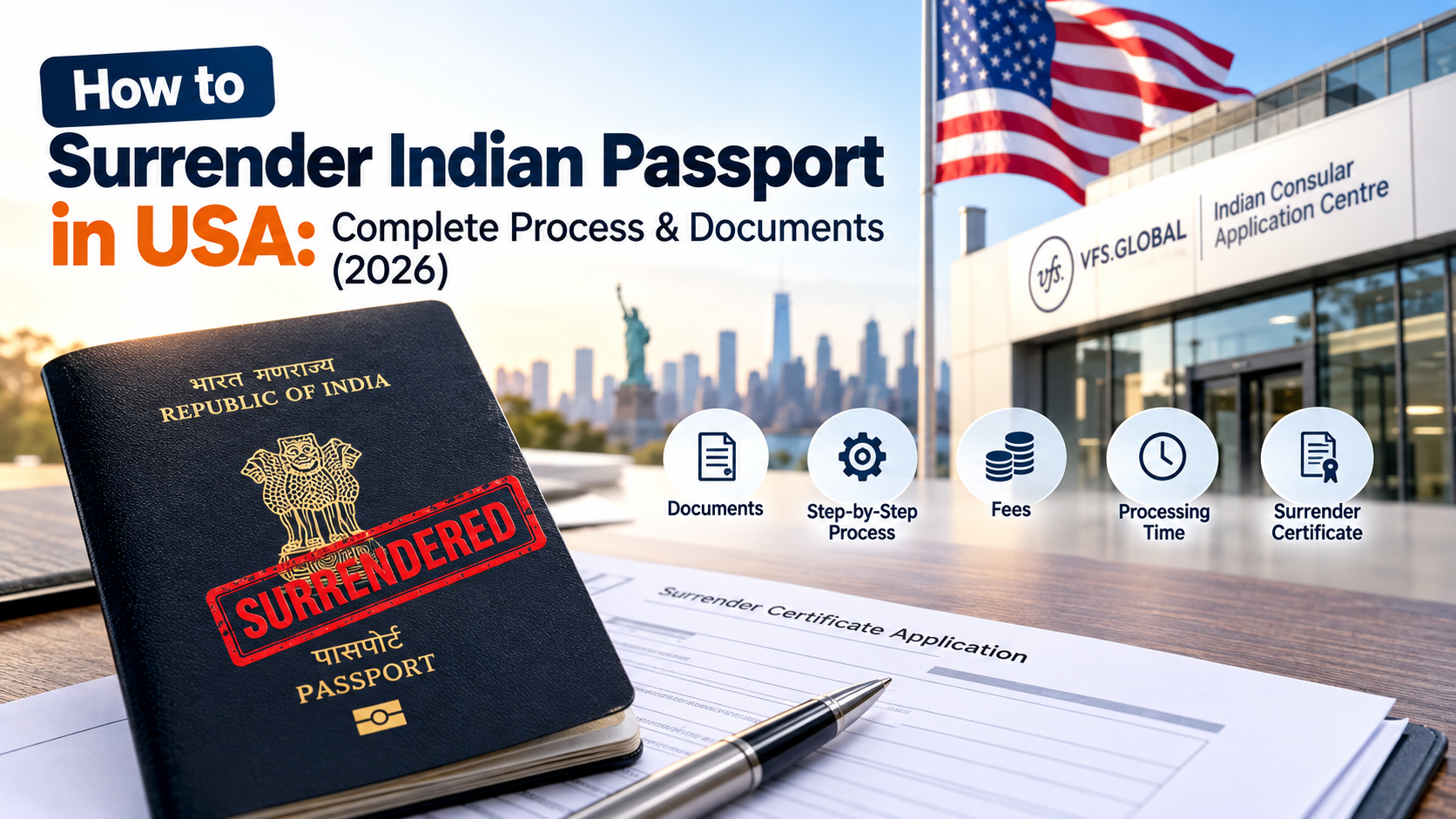
If you have acquired foreign citizenship after being an Indian citizen, you may need to surrender your Indian passport and obtain the relevant certificate. This document can be important when applying for an Overseas Citizen of India (OCI) card or certain Indian consular services.
The process, required documents, fees, and processing times vary depending on your country of residence and the applicable Indian mission. Understanding the difference between a Surrender Certificate and a Renunciation Certificate is also important before you apply.
In this guide, you'll learn who needs a Surrender Certificate, which documents may be required, how the application process works, what fees to expect, and how the certificate relates to an OCI application.
A Indian Passport Surrender Certificate is an official document issued by an Indian embassy or consulate. It confirms that you have handed over your Indian passport for cancellation after acquiring foreign citizenship.
India does not allow dual citizenship. Once you become a citizen of another country, your Indian citizenship ends by law, and holding on to the Indian passport becomes a problem. Indian missions describe keeping an Indian passport as a foreign national as a serious offence under the Passports Act.
You need this certificate if:
If you were born in India but never held an Indian passport, this certificate is generally not meant for you.
People often mix these up, and the confusion causes rejected applications.
Some missions treat them as two separate services, so check what your consulate asks for. If your passport was lost, you’ll usually be asked for a declaration or police report instead of the original.
If you've acquired foreign citizenship, your Indian Passport Surrender Certificate may be an important document when applying for an OCI card or completing certain Indian consular formalities.
It helps establish that you've surrendered your former Indian passport following your acquisition of foreign citizenship. Depending on your circumstances and the applicable Indian mission's requirements, you may need to submit this certificate or other relevant surrender or renunciation proof with your OCI application.
If you're planning to apply for an OCI card, make sure you understand the document requirements before applying to avoid unnecessary delays and this certificate is one among those required documents.
Exact checklists vary by country, but most missions ask for:
If your Indian passport is lost: you’ll typically need a police report or FIR mentioning the passport number, plus a signed declaration. These applications usually take longer because the mission needs clearance from authorities in India.
If your passport has expired: you can still apply. An expired passport doesn’t block a surrender certificate.
There is no single global fee. Each mission charges in local currency, and rates get revised when exchange rates change. Some examples from official mission pages:
Always confirm the current figure on your consulate’s official page before paying. Fee tables change, and a wrong amount can delay your application.
Processing times depend on the mission and on how clean your case is.
These timelines assume a complete application. Lost passports, missing documents or unclear histories add time.
If you kept your Indian passport for more than three years after getting foreign citizenship, or travelled on it after naturalising, expect delays. Missions say the processing time for such cases can’t be fixed in advance because they need clearance from Indian authorities. In some cases, additional fees or penalties may apply.
Our expert can help you? Get help understanding your OCI eligibility, required documents, and application process based on your circumstances.
Get OCI Application Assistance →Related Article
Obtaining an Indian Passport Surrender Certificate is an important step after acquiring foreign citizenship. Having the correct documents requirements and understanding the application process beforehand helps you avoid unnecessary delays, especially if you're planning to apply for an OCI Card.
One more important advice for you —check the latest requirement, fees, and the processing times published by the relevant Indian Embassy or consulate, as these may vary country to country and according to the Individual circumstances.
So, if you are planning for applying your OCI Card, you must first get your Indian Passport surrender certificate ready with you and review the applicable OCI requirements before starting your application. If you need any further guidance related to OCI application or OCI Miscellaneous Services, get in touch with our experts for personalised assistance and make your OCI application journey simpler and more hassle-free.
Note: This guide is for information purposes only. HelpOCI or the author will not be responsible for any direct or indirect loss incurred by the reader for taking any decision based on the information or the contents. It is advisable to consult a qualified professional for guidance based on your exact situation.
Anil is an NRI documentation and immigration specialist at HelpOCI, a trusted platform dedicated to simplifying OCI, PAN, Visa, Passport, and NRI-related services for applicants worldwide. With extensive expertise in Indian consular services, overseas documentation, OCI applications, PAN card services, visa assistance, passport renewals, and NRI compliance, Anil is committed to making complex government procedures easier to understand and navigate. By combining in-depth research with official government guidelines, Anil creates practical, accurate, and easy-to-follow resources that help applicants complete their documentation confidently and efficiently See Full Bio
Get reliable support for every step, whether it's form filling or final submission.




Want to read more? Explore Blogs
Comments