
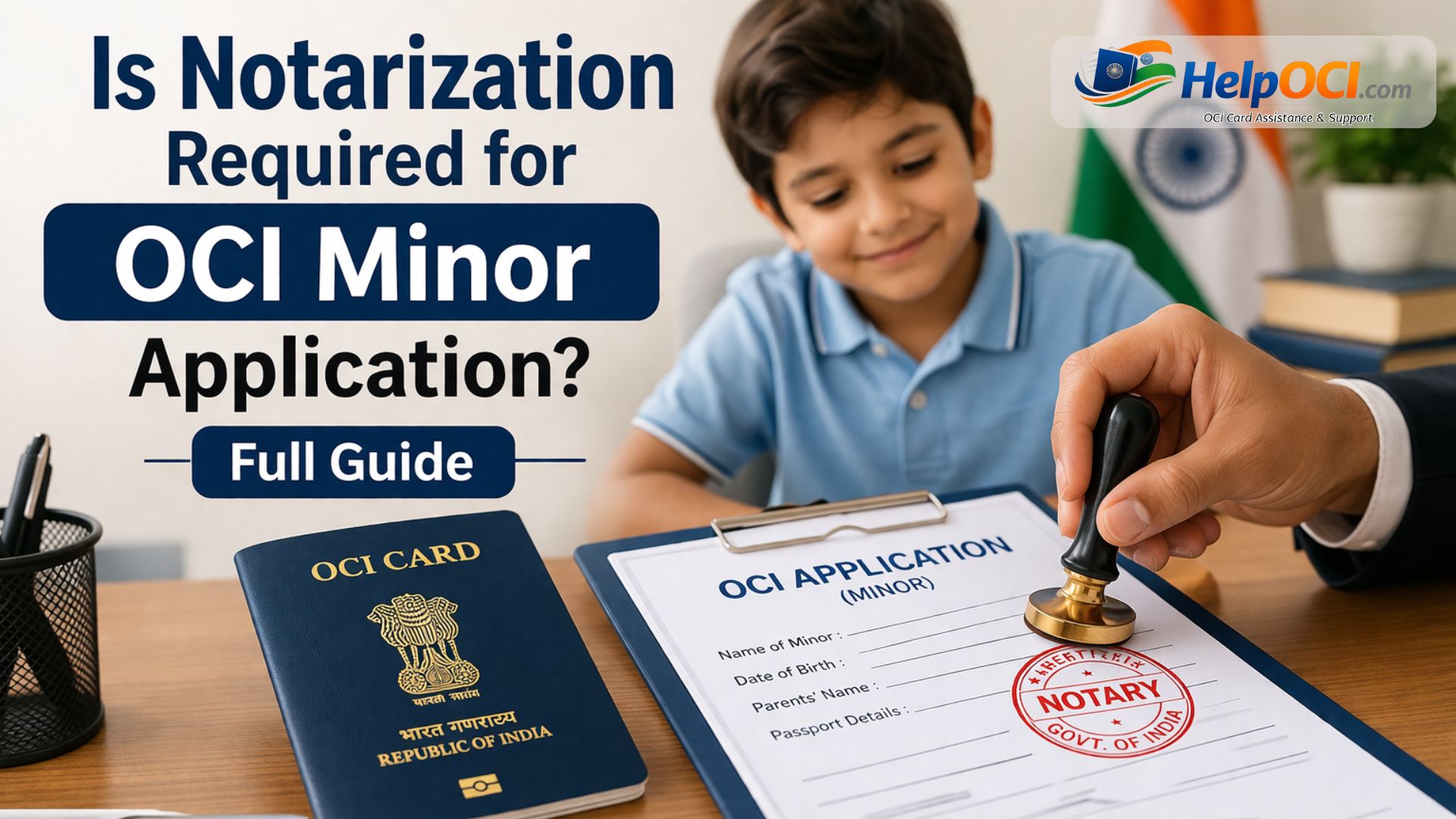
Getting an OCI card for your child should be a smooth process but many families run into confusion when it comes to notarization requirements. After filling out forms and gathering documents, this is often the step where things get unclear. Official instructions can be vague, and online advice is often inconsistent, making it hard to know what’s actually required.
Even a small mistake like a missing notary stamp or incorrectly notarized document—can lead to rejection, delays, and the need to start over. That means wasted time, extra costs, and unnecessary stress.
In this guide, we’ll simplify everything for you. You’ll learn Is Notarization Required for OCI Minor Application? Full Guide, and how to avoid common mistakes so you can complete your child’s OCI application correctly the first time.
Read Also:- OCI Card New Rules 2026: Latest Updates You Must Know
What is Notarization?
Think of notarization as an official witness. A Notary Public is a state-appointed official who verifies your identity, watches you sign a document, and then stamps and signs it themselves. Their seal confirms that you are who you say you are and that you signed the document willingly. It adds a layer of legal authenticity to a document, which is why government agencies often require it for important applications. It’s not about checking if your information is correct; it’s about verifying the signature is legitimate.
Is Notarization Required for OCI Minor Application?
Want to know Is Notarization Required for OCI then let us let us Yes, in most cases, some form of notarization is required. The key document is almost always the Parental Authorization Form.
The requirement isn’t optional if it applies to your situation. The Indian government needs to be absolutely sure that both legal parents consent to the child receiving Overseas Citizenship of India. Notarization is their method for verifying this consent, especially when the application is submitted from outside India. Ignoring this step is a guaranteed way to get your application sent back.

When is Notarization Mandatory for OCI Applications?
Notarization becomes non-negotiable in several specific scenarios. We’ve seen applications returned for every one of these.
Applying from Outside India
If you are submitting the OCI minor application through a service like VFS Global in the USA, Canada, UK, or another country, you will almost certainly need to get the Parental Authorization Form notarized. This is the most common trigger for the notarization requirement.
Single, Divorced, or Widowed Parent
If only one parent has legal custody of the child, you can’t just skip the other parent’s signature. You will need to provide legal documents proving your sole custody (like a court order) and often an affidavit explaining the situation. This affidavit must be notarized. If a parent is deceased, a death certificate is needed, but an accompanying self-declaration may also need notarization depending on the consulate’s rules.
Parents with Different Nationalities
If one parent is an Indian citizen and the other is not, the non-Indian parent’s consent is critical. Their signature on the Parental Authorization Form will need to be notarized to confirm their agreement.
Signatures Don’t Match
If a parent’s signature on the application form looks different from their signature on their passport, a consulate might question it. A notarized form helps validate that the signature is genuine.
Documents That May Require Notarization
Focus on these specific documents. Getting the wrong ones notarized is a waste of money, and missing the right ones is a cause for rejection.
- Parental Authorization Form:- This is the big one. This form confirms that both parents give their consent for the minor to be granted OCI status. In almost all applications submitted outside India, this form needs to be signed by both parents in front of a notary.
- Affidavit for Single Parent:- If you are a single parent with sole custody, you’ll need to submit a notarized affidavit stating this fact, along with supporting legal documents.
- Affidavit for Name/Signature Discrepancy:- If a parent’s name is spelled differently across documents (e.g., passport vs. marriage certificate), a notarized affidavit explaining the discrepancy might be required.
- Consent Letter (Specific Cases):- Sometimes, if parents are in different locations, a separate notarized consent letter from the non-applying parent may be needed.
Documents That Do Not Require Notarization
Do not waste money getting these notarized. A simple self-attestation is all that’s needed. Self-attestation just means you sign the photocopy yourself, writing “Self-Attested” on it.
- Copies of Parents’ Passports
- Copy of Minor’s Birth Certificate
- Copy of Parents’ Marriage Certificate
- Copy of Proof of Address
- Copies of Parents’ OCI Cards (if applicable)
- Copy of Minor’s Foreign Passport
For these, you just need clear photocopies signed by one or both parents as instructed on the checklist.
OCI Minor Application Rules (India vs Abroad)
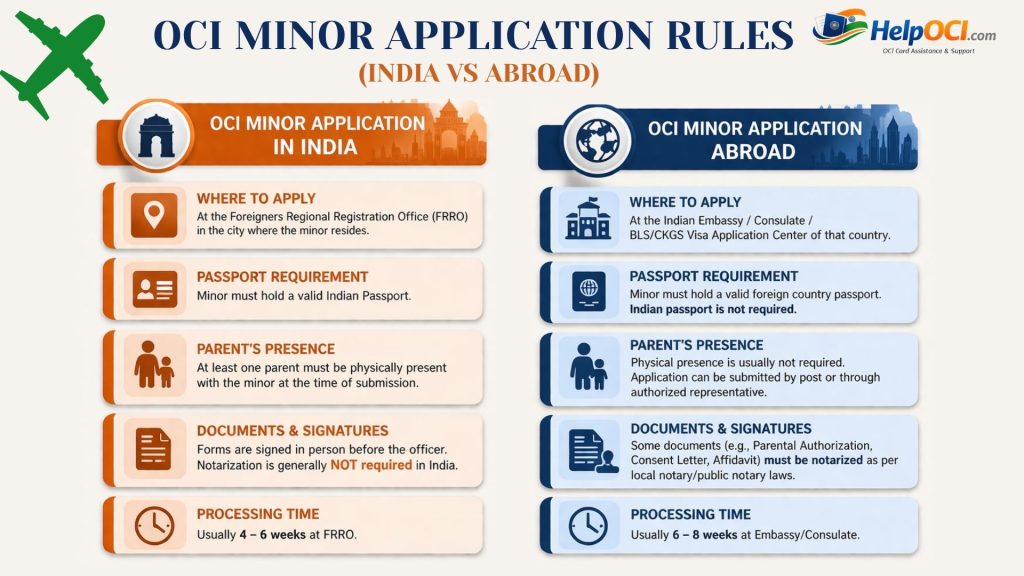
The rules are not the same everywhere. This is a critical point that many people miss.
Applying from Abroad – e.g., USA, UK, Canada
When applying through an intermediary like VFS Global, the `OCI minor notarization` rules are stricter. The consulates rely on the notary system of that country to verify parental consent. The Parental Authorization Form almost always needs to be notarized. You must follow the checklist provided by the specific Indian consulate that has jurisdiction over your area (e.g., the consulate in New York may have slightly different wording on its checklist than the one in San Francisco).
Applying in India
If you are physically in India and applying for a minor’s OCI through the Foreigners Regional Registration Office (FRRO), the process can be different. Often, they require the parents to be physically present during submission. In these cases, they might verify your identity and signatures in person, sometimes bypassing the need for a notary. However, it’s still best practice to check the specific FRRO’s latest requirements, as rules can and do change.
Do Both Parents Need to Sign in Front of a Notary?
Yes. The entire point of notarizing the Parental Authorization Form is for the notary to witness both parents signing it.
Both parents should ideally go to the notary at the same time. You will need to present your photo IDs (like a driver’s license or passport) to the notary. The notary will watch you sign, ask you to affirm you are signing willingly, and then apply their seal and signature. If parents are in different cities or states, they may need to get their signatures notarized separately on the same form or on two separate consent forms, but this complicates things. It’s best to check with the specific consulate if this is your only option.
Common Notarization Mistakes to Avoid
We have seen these mistakes sink applications. Avoid them at all costs.
- Missing Notary Seal or Signature:- The notary must both sign the document and apply their official stamp or seal. If either is missing, the notarization is invalid.
- Notarizing a Photocopy:- You must sign the original Parental Authorization Form in front of the notary. Do not sign it first and then take a copy to be notarized.
- Forgetting Your ID:- You cannot get a document notarized without valid, government-issued photo identification. The notary needs to verify who you are.
- Using an Out-of-State Notary:- Generally, the notarization should be done in the state where you reside and are submitting the application from. Using a notary from a different state can raise questions.
Tips to Avoid OCI Application Rejection
- Read the Checklist. Twice:- The most up-to-date requirements will be on the VFS Global or Indian consulate website for your specific jurisdiction. Print it out and tick off every item.
- Match Names Exactly:- The minor’s name and parents’ names must be spelled identically across all documents, passports, birth certificate, marriage certificate. No exceptions.
- Photo and Signature Specs are Strict:- The digital and physical photos have precise size and background requirements. The minor’s thumbprint or signature must be inside the designated box on the application form. Don’t eyeball it.
- Find a Reputable Notary:- Use a notary at a bank, a UPS Store, or a law office. They are familiar with the process and less likely to make mistakes.
FAQs (Is Notarization Required for OCI )
1. Can we use an online or remote notary for the OCI application?
From what we’ve seen, this is risky. Most Indian consulates expect a traditional, in-person “wet ink” notarization with a physical stamp. While remote notarization is legally valid in many US states, government agencies for foreign countries are slow to adapt. We strongly advise using a traditional, in-person notary to be safe.
2. What if one parent is unavailable to sign or is uncooperative?
This requires legal documentation. If you have sole legal custody due to a divorce, you must provide the court order. If a parent is simply uncooperative, you cannot proceed without their signature unless you have a court order granting you the sole authority to apply for the child’s passport and citizenship documents. The Indian government will not get involved in parental disputes.
3. The Parental Authorization Form from the government website doesn’t mention notarization. Should I still do it?
Yes. The generic form may not state it, but the checklist for your specific consulate or VFS center will. The checklist overrules the generic form. If the VFS checklist for your jurisdiction says “Notarized Parental Authorization,” then you must get it notarized.
Conclusion- Is Notarization Required for OCI Minor Application? Full Guide
The notarization process is a simple but strict gatekeeper for your child’s OCI application. Get it right, and you’re on your way. Get it wrong, and you’re facing delays. There is no middle ground. Double-check the Parental Authorization Form. Ensure both parents have signed it, their signatures are notarized with a clear seal and date, and it’s the original document.
Looking ahead to 2026, we expect more digitization, but key verification steps like parental consent will likely remain physical or require advanced digital identity verification for a long time. For now, the notary’s stamp is your key to a smooth process.