
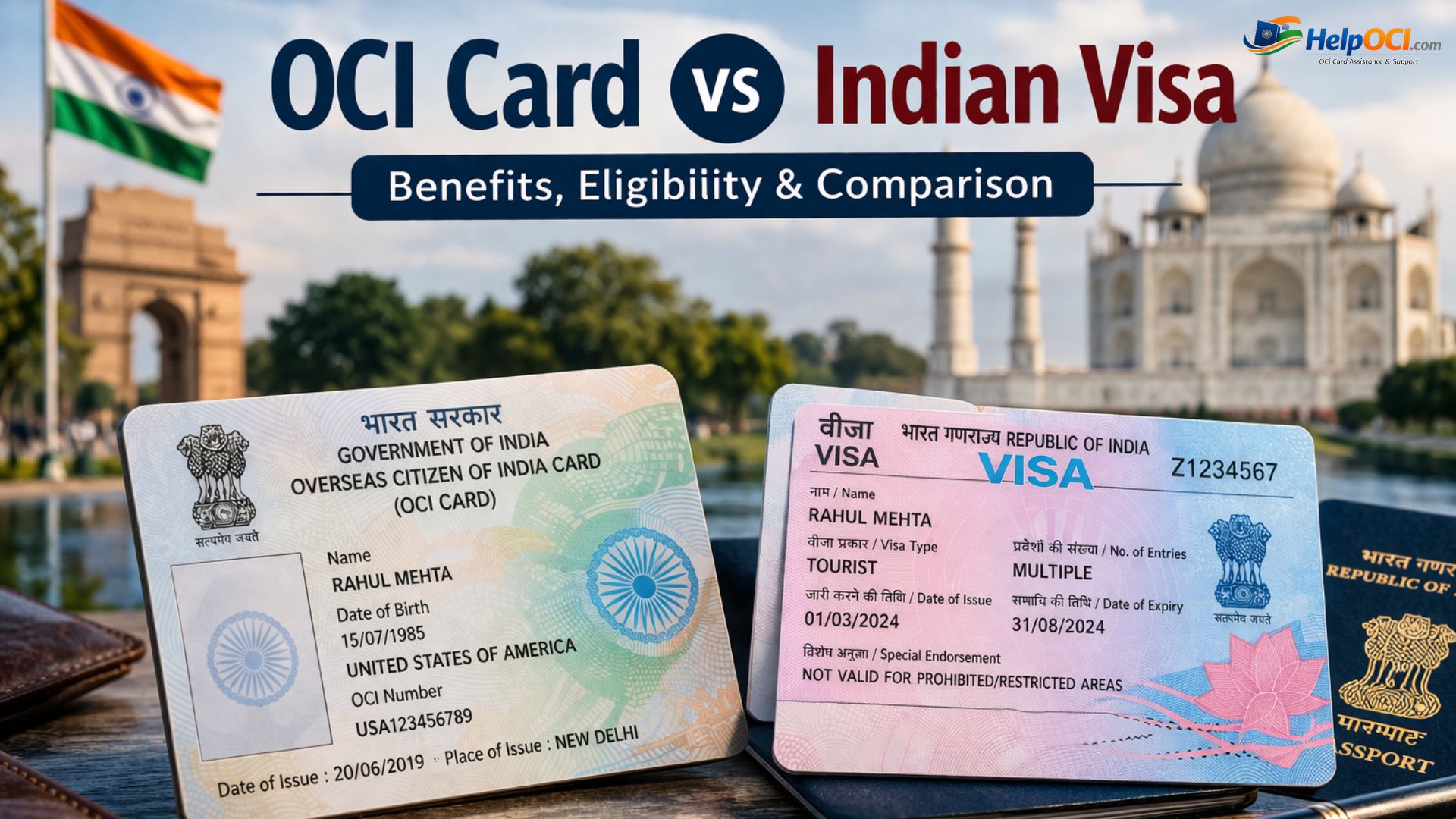
The whole OCI card vs Indian visa debate isn’t just paperwork; it’s a strategic decision with long-term consequences that we see people mess up constantly. The biggest mistake is thinking the OCI is a form of dual citizenship, it is absolutely not, and that misunderstanding can lead to serious legal and financial headaches down the road. This topic has gained significant attention in recent years. Many individuals of Indian origin who moved abroad decades ago are now looking to reconnect with India—whether for family, investment, or retirement purposes. At the same time, younger generations born overseas often view India as an important cultural and personal link. Adding to this, the introduction of streamlined eVisa options has made short-term travel easier, but also more confusing when choosing between temporary and long-term solutions.
In this guide, we break down the differences between an OCI card and Indian visa in clear, practical terms. From eligibility requirements to real-world benefits and limitations, this comparison will help you decide which option best suits your needs.
Read Also:- How Long US Citizen Can Stay in India with OCI – Stay Rules
What is an OCI Card?
An Overseas Citizen of India (OCI) card is not a second passport, nor does it grant dual citizenship. Instead, it functions as a lifelong, multiple-entry visa that is linked to your foreign passport and issued along with an OCI booklet. In practical terms, it provides long-term access to India without the need for repeated visa applications.
Designed for individuals of Indian origin and their eligible spouses, the OCI card offers significant convenience and flexibility. It allows holders to live, work, and travel freely in India without the requirement of frequent visa renewals or mandatory registration with the Foreigners Regional Registration Office (FRRO).
Additionally, OCI cardholders enjoy many economic, financial, and educational benefits similar to those available to Non-Resident Indians (NRIs). This makes the OCI card a highly valuable option for those seeking long-term engagement with India, whether for personal, professional, or investment purposes.
Benefits of OCI Card
The benefits are substantial, provided you qualify and are willing to go through the initial paperwork slog.
- Lifelong Visa:- You get multiple entries for any purpose, for life. No more planning trips around visa application timelines.
- No Police Reporting:- For any length of stay in India, you are exempt from registering with the FRRO. This alone saves you from one of the most soul-crushing bureaucratic processes in the country.
- Economic Parity with NRIs:- You can open Indian bank accounts, invest in stocks, and—this is the big one—purchase non-agricultural/non-plantation property.
- Work Rights:- OCI holders can take up private sector employment without needing a separate work permit. This is a game-changer for professionals wanting to work in India.

What is an Indian Visa?
An Indian visa is a standard, temporary travel authorization that allows foreign nationals to enter India for a specific purpose and a defined period. It may be issued as a physical stamp or sticker in your passport, or as a digital document in the case of an eVisa.
India offers a wide range of visa categories, including Tourist, Business, Medical, Conference, and Student visas, each tailored to a particular type of visit. Every visa type comes with clearly defined conditions outlining permitted activities and duration of stay.
It is important to strictly adhere to these conditions. Any violation, such as engaging in employment while on a tourist visa can result in serious consequences, including fines, deportation, or even being blacklisted from future entry into India.
Benefits of an Indian Visa
The primary benefit is speed and convenience for short-term travel.
- Fast Processing:- The Indian eVisa system is remarkably efficient. You can often get an approval within 24-72 hours. It’s perfect for last-minute trips.
- Simplicity:- The application is straightforward and requires minimal documentation compared to the OCI.
- Purpose-Specific:- It’s a clear, fit-for-purpose tool. You need to attend a wedding? Get a tourist visa. You have a business meeting? Get a business visa. No long-term commitment.
OCI Card vs Indian Visa: Key Differences
The core differences between an OCI card and an Indian visa come down to permanence and legal status.
Permanence
In the OCI Card vs Indian Visa debate, the main difference is permanence. OCI provides lifelong, multiple-entry access to India, whereas an Indian visa is temporary and must be renewed or reapplied for each visit.
Legal Status
OCI holders enjoy long-term residency and NRI-like rights in India, while Indian visas only allow short-term entry without granting property, work, or long-term legal privileges.
Purpose and Use
The OCI Card vs Indian Visa choice depends on purpose: OCI is ideal for living, working, studying, or investing, whereas visas are limited to tourism, business trips, conferences, or medical treatment.
Work, Study, and Economic Rights
In the OCI Card vs Indian Visa comparison, OCI allows employment, business operations, education, and property ownership, while most visa types restrict activities to their defined purpose.
Application and Renewal
If we talk about the difference between OCI Card vs Indian Visa, OCI requires minimal maintenance, mainly updating passports, but visas involve repeated applications, extensions, and possible FRRO registration for long stays.
Eligibility Criteria for OCI Card
This is where people get stuck. Eligibility is based on your Indian heritage. You generally qualify if:
- You were eligible to become a citizen of India on January 26, 1950.
- You were a citizen of India on or after that date.
- You are the child, grandchild, or great-grandchild of such a person.
Crucially, anyone who has ever been a citizen of Pakistan or Bangladesh is generally ineligible. No exceptions. We’ve seen applications rejected for this without appeal.

Eligibility Criteria for Indian Visa
This is much simpler. Eligibility is based on your current nationality. If you hold a passport from a country that India maintains diplomatic relations with and isn’t on a restricted list, you can apply for a visa. Your ancestry is irrelevant.
Expert Pro Tips / Off-the-Record Advice
- OCI is NOT Dual Citizenship:- We have to repeat this. You are a foreign citizen holding a long-term visa. Don’t show up at the polls on election day.
- The Ancestral Paper Trail is Everything:- Before you even start the OCI application, locate your (or your parents’/grandparents’) surrendered Indian passport or other proof of origin. Without this, your application is dead on arrival. Don’t throw away old documents.
- Triple-Check Your eVisa Application:-The online eVisa system is automated and has no mercy. A single typo in your name or passport number will result in a rejected ETA, and you will have to re-apply and pay again. We’ve seen people denied boarding for this.
- Don’t Apply for OCI While in India:- If you’re in India on a tourist visa, don’t try to convert it to an OCI or apply for one from within the country. The bureaucracy involved is ten times worse. Go back to your country of residence and apply from there.
Conclusion
The `OCI Card vs Indian Visa` divide will only become sharper. For tourists and short-term business travelers, the eVisa system will continue to expand and become even more efficient—it’s a revenue generator. But for the OCI, don’t expect it to get easier. It is a gate-kept privilege, not a right. By 2026, we anticipate more stringent back-end checks and biometric linking for OCI applicants. The Indian government views the OCI as a tool to engage its skilled diaspora, not as a shortcut to residency for the merely curious. Choose your path based on your long-term intent, not short-term convenience.
FAQ
Q: I have an OCI card. Do I need to carry my foreign passport too?
Yes, absolutely. The OCI is only valid when presented with your current, valid foreign passport. The OCI booklet itself is not a travel document.
Q: 2 My parents are Indian citizens. Can I, a US citizen, just apply for Indian citizenship instead of OCI?
It’s extremely difficult. India does not recognize dual citizenship. You would have to renounce your US citizenship, and the process for naturalization in.