
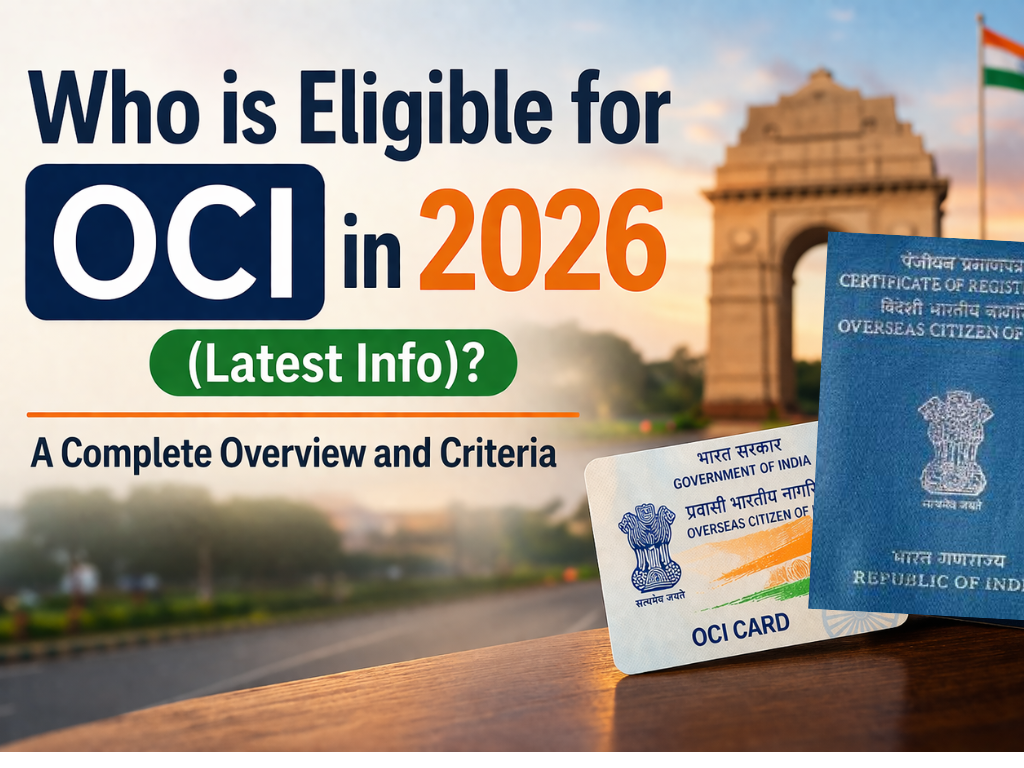
Do you want to know who is eligible for OCI? This is the single most important step in the entire process; millions have secured this status since its inception. People look this up because the rules are so complicated that people get confused whether they are eligible or not. We’re going to lay out the eligibility criteria for OCI in this article.
Core Eligibility for OCI- Direct, Ancestry & Marriage Routes
The Direct Path: Former Indian Citizens
If you were an Indian citizen in the past (after 1950), you are eligible for OCI
It’s that simple. After you surrendered your Indian citizenship and acquired foreign nationality, you became eligible to apply for OCI.
The only major exception to this rule involves individuals who later acquired citizenship from Pakistan or Bangladesh; in our experience, those applications are not processed.
This path requires you to prove you once held Indian citizenship, typically with a surrendered Indian passport and a surrender certificate.
The Ancestral Path: Indian Origin
This is where most of the confusion happens. Eligibility extends to those who were never Indian citizens themselves but have Indian ancestry.
The rule is this:
- You are eligible if you belonged to a territory that became part of India after August 15, 1947.
- You also qualify if at least one of your parents, grandparents, or great-grandparents was born in India or was a citizen of India at the time the Constitution came into effect.
Here’s the complete Overview we use internally:
Parents/Grandparents: If either of your parents or grandparents was a citizen of India on or after January 26, 1950, you have a clear path.
Great-Grandparents: This is the furthest back the lineage typically goes. If a great-grandparent was eligible, you might be too, but the documentation requirements become much stricter. From what we’ve seen, you need to establish an unbroken chain of relationships.
Proof is everything: You need to prove this lineage. We’ve successfully used documents like old birth certificates, educational records from Indian institutions, or even property documents that clearly state the ancestor’s name and connection to India. The official OCI Services portal lists accepted documents.
The Spousal Path: Foreign Spouses
A person of foreign origin can become Eligible for OCI through their spouse. This isn’t an automatic grant; specific conditions must be met.
The applicant’s spouse must either be a citizen of India or an existing OCI cardholder. The key requirement is that the marriage must be registered and have subsisted for a continuous period of at least two years immediately before you submit the application.
You must also provide a joint declaration confirming the marriage is genuine. If the Indian spouse passes away or the couple divorces, the OCI status granted on this basis is typically revoked.
NAVIGATING THE FINE PRINT
Getting the paperwork right for lineage-based applications is where people stumble.
Don’t just rely on a birth certificate. We’ve seen applications move forward because a client found an old Domicile Certificate issued by a competent authority or even a school leaving certificate mentioning the ancestor’s place of birth in pre-independence India.
The system responds to concrete, official proof of connection to Indian territory, no matter how old. Another point of friction is for minor applicants.
If parents are separated or divorced, a court order granting full custody to the applying parent is non-negotiable.
A simple consent letter from the other parent often isn’t enough; the application processing teams look for official legal documentation that leaves no room for ambiguity about the child’s guardianship. This is a hard stop for many applications we’ve reviewed. Finally, understand that the “never a citizen of Pakistan or Bangladesh” rule is absolute. It applies not just to you, but to your entire ancestral line being used for eligibility. If your father, mother, or any grandparent was ever a citizen of either of these nations, the path to OCI is closed. There is no workaround for this.
FINAL VERDICT
OCI is more than a visa; it’s a recognition of a lifelong connection to India. Before you get lost in forms and appointments, your first job is to honestly assess your history against these core criteria. Getting this right from the start saves you time, money, and immense frustration.
FIELD QUESTIONS
Q1: I was born in the USA, but both my parents are Indian citizens. Am I eligible for OCI ?
Yes, absolutely. You are eligible based on your parents’ Indian citizenship. This is one of the most common and clear-cut eligibility scenarios. You will need to provide your birth certificate along with your parents’ Indian passports as proof.
Q2: My grandfather was born in Lahore in 1930, which was part of British India. Do I qualify?
No. While Lahore was part of British India, it became part of Pakistan after 1947. Since eligibility is tied to territories that became part of the Republic of India, and there’s a specific restriction against ancestry from Pakistan, this lineage would not make you Eligible for OCI.
Q3: My spouse is an OCI cardholder. Can I apply immediately after our wedding?
No. You must wait until your marriage has been registered and has been continuous for at least two full years before you can submit your OCI application. Applying even one day early will result in a rejection.